

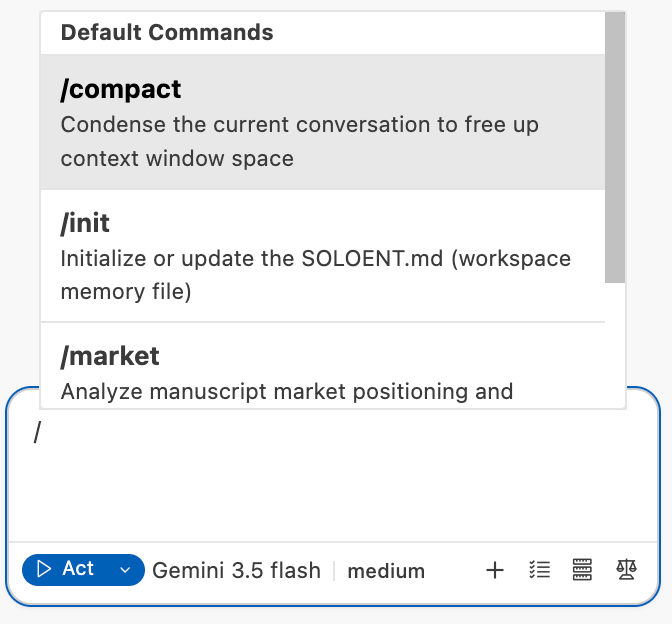
/ in the editor to invoke these specialized tools.
Think of commands like power tools in your workshop. Instead of manually checking every detail, you invoke a command and let the Agent run a comprehensive workflow for you.
How to Use Commands
1
Type / in the editor
Press
/ (forward slash) to open the command palette.2
Select a command
Choose from the list of available commands (e.g.,
review, market).3
Agent runs the workflow
The Agent automatically executes the pre-configured workflow and generates a detailed report.
4
Review the results
The Agent saves the report to your
notes/ directory and provides actionable suggestions.Built-in Commands
SoloEnt currently provides four official commands. Here is what each does at a glance:/review - Quality Assurance
The /review command runs a multi-layered quality assurance process on your chapter:
1. Basic Review
1. Basic Review
- Word count: Checks if chapter length matches your target
- Outline alignment: Verifies the chapter follows your planned outline
2. Consistency Review
2. Consistency Review
- Story continuity: Compares with story outline and act structure
- Chapter flow: Checks consistency with previous chapter
- Character integrity: Verifies characters act according to their profiles
- World rules: Ensures no violations of established world-building
3. Writing Style Review
3. Writing Style Review
- Style guide compliance: Checks against your stylistic guidelines (Section 5 of SOLOENT.md)
- Character voice: Ensures characters speak and act consistently
- Tone consistency: Verifies the chapter maintains the intended atmosphere
4. Chapter Ending Review
4. Chapter Ending Review
- Hook quality: Ensures chapter ends with a compelling hook
- Ending pitfalls: Flags repeated words, long inner monologues, or weak endings
- Next chapter connection: Verifies smooth transition to next chapter
5. AI Writing Pattern Detection
5. AI Writing Pattern Detection
- Originality check: Verifies text doesn’t reproduce copyrighted material
- Repeated phrases: Detects overused words or phrases
- Em dash overuse: Flags unnecessary em dash usage
- List pattern abuse: Catches “word, word, word” patterns common in AI writing
/market - Publishing Strategy
The /market command analyzes your completed manuscript and generates a comprehensive publishing strategy:
1. Genre & Market Analysis
1. Genre & Market Analysis
- Primary genre: Identifies your book’s genre and subgenre
- Word count: Calculates per-chapter and total word count
- Market category: Determines MG/YA/Adult and Fiction/Non-fiction classification
2. Story Elements Extraction
2. Story Elements Extraction
- Logline: Crafts a one-sentence hook for your story
- Main selling points: Identifies unique elements that make your book marketable
- Comparable titles: Suggests “comp titles” for query letters
3. Publishing Route Recommendation
3. Publishing Route Recommendation
- Best-fit route: Traditional, Hybrid, Self-publishing, or Fandom platforms
- Rationale: Explains why this route fits your manuscript
- Target platforms: Specific publishers, imprints, or self-publishing platforms
- Next steps: Query letter, editing needs, cover design, etc.
4. Success Benchmarks
4. Success Benchmarks
- Comparable titles: Books similar to yours and their success metrics
- Timeline: Expected timeline to publication
- Budget: Estimated costs (for self-publishing or hybrid routes)
More Advanced Tips
SOLOENT.md Guide
Learn how commands interact with your project constitution
Plan Mode
Use Plan Mode to structure your story before writing