

What is the context window?
Every session window has a context-length limit. Above the chat box you can see how much context the current window has used — for example the 30.2k / 300.0k below: the left number is the used session size, and the right number is the current session’s context ceiling.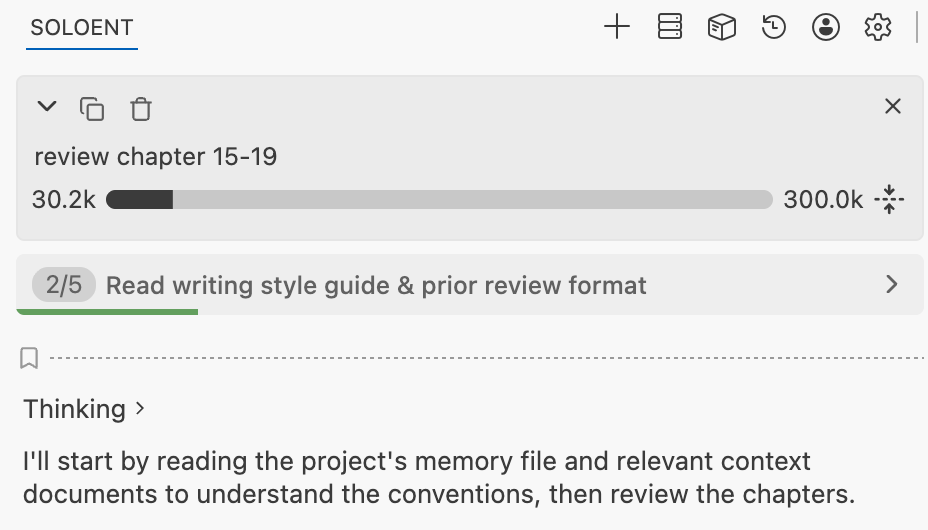
Setting the context ceiling
A single session’s context ceiling is determined by the model’s capability; today’s mainstream models already support up to 1M. SoloEnt lets you set the per-session context ceiling to a reasonable level as needed.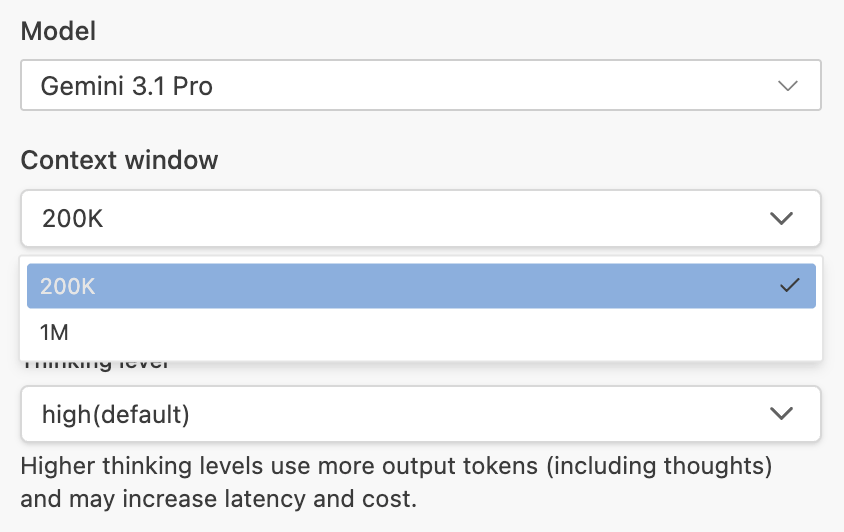
- Keep it around 200K–300K.
- Common practice: following mature Agent products like Codex Cloud, people usually use only the first tier (200K–300K) of context and rarely go higher.
Why we don’t recommend maxing out a single 1M window
Surging cost of one long-running session
Surging cost of one long-running session
Many users assume a single window brings caching advantages, but some models charge in tiers based on session size, so an overly long session risks a cost surge.
Example: with some models, input/output below 256K is one price tier, and above 256K it rises noticeably — a clear tiered price jump.
Uncertainty of the cache
Uncertainty of the cache
While most new models offer good caching (a cache hit may cost only 1/5 to 1/10 of the price), sessions spanning days or long idle gaps cause the cache to expire, so a single request consumes a lot of tokens.
Switching models = starting over with a huge context
Switching models = starting over with a huge context
If you switch models partway through a single window, the new model actually has to read all the context the old model accumulated, which can consume a large chunk of the session at once — very uneconomical. Always summarize the prior session before switching models.
Best practices
Switching windows means giving up the current window’s session history, which feels wasteful to many users; but over-relying on a single window is neither economical nor good for long-term context quality in practice.- Task isolation: aim for “one session, one task,” and check completion before moving on.
- If the next task is related: summarize the current session, offload it to a project file (such as
SOLOENT.md), then continue in a new session. - If the next task is unrelated: decisively open a new session to avoid piling up historical tokens.
- If the next task is related: summarize the current session, offload it to a project file (such as
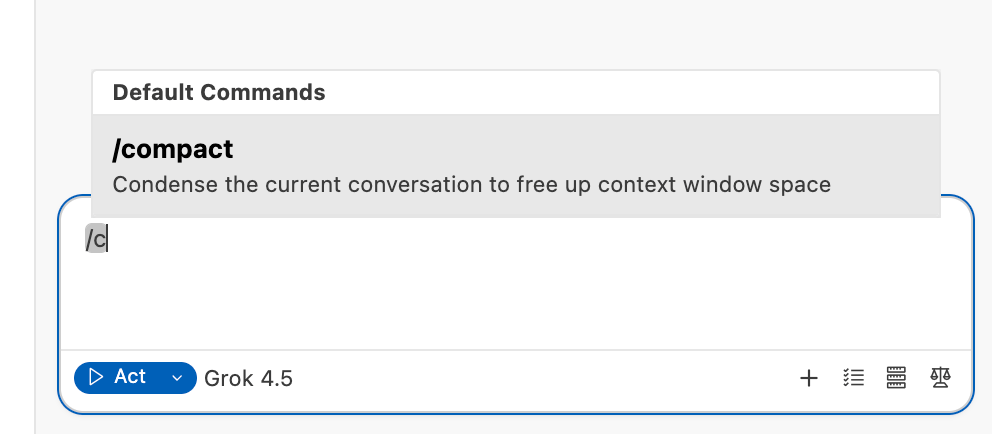
- Use session compaction: when a session gets too full, use the
/compactcommand to condense the current content into a short summary and use it as the starting input for a new session — preserving the core information while lowering token usage.
- Once context usage passes about 200K, continuing may cause a cost surge; a good rule of thumb is to consider opening a new window when a single window reaches 100–150K.
Always summarize and offload before opening a new window
- Long-form fiction: use
/initto generateSOLOENT.mdin your project and write key context — characters, outline, current progress — into it. Each new window lets the model quickly restore the full project picture by readingSOLOENT.md, rather than relying on context accumulated in a single session. - After heavy discussion: if you and the Agent have discussed a lot and context is running high, ask the Agent to summarize the current discussion before switching windows (or models) and land the conclusions in a readable document. After switching, read that document first to get back up to speed.
SOLOENT.md Guide
Use a memory file to carry long-term context so every new session quickly restores the full picture
Commands
Learn how to use built-in commands like
/compact and /init